Could Gravity Emerge from Quantum Entanglement — and Could Electric Fields Influence It?
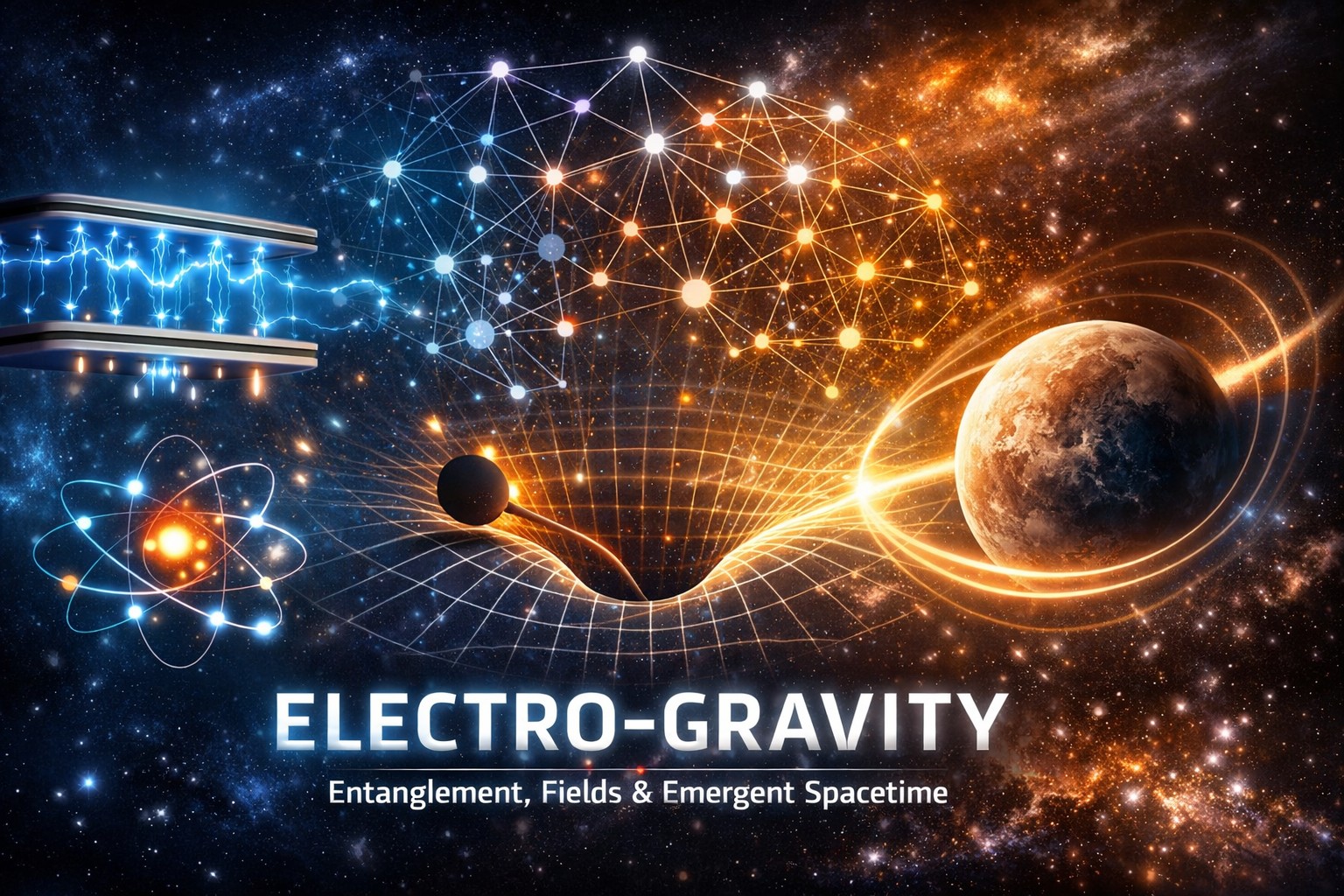
Speculative physics at the edge of spacetime, information, and fields
Introduction: Questioning What We Call “Fundamental”
For over a century, physics has treated spacetime as the stage on which everything happens. Matter moves through it, fields exist within it, and gravity curves it. But modern theoretical physics is increasingly challenging this picture.
What if spacetime itself is not fundamental?
What if geometry, motion, and even gravity are emergent phenomena, arising from something deeper — like quantum entanglement?
And if that’s true, a provocative question follows:
Could electric fields, by reshaping quantum entanglement, indirectly influence spacetime geometry — creating something like “electro-gravity”?
This post explores that idea carefully, separating what is known, what is speculative, and where the real obstacles lie.
Spacetime as an Emergent Structure
In general relativity, spacetime geometry is determined by energy and momentum. Matter doesn’t merely move in spacetime — it co-determines spacetime.
But newer approaches go further. They suggest that:
- Spacetime geometry may emerge from quantum correlations
- Distance may correspond to entanglement strength
- Curvature may reflect entanglement density gradients
In this view, spacetime is not continuous by default. Instead, it emerges at large scales from an underlying quantum network — sometimes imagined as a mesh, graph, or relational structure.
Motion Without Motion
If spacetime geometry is emergent, then motion itself must be reconsidered.
Traditionally:
- Motion = change of position over time
But if:
- Position is not fundamental
- Distance is defined by entanglement
- Geometry itself evolves
Then motion may simply be:
The reconfiguration of relational structure over time
In other words, objects don’t necessarily move through space —
the network defining space updates around them.
This reframes inertia, geodesics, and even Newton’s first law as consequences of how stable or resistant entanglement structures are to change.
Energy Density in a Quantum Mesh
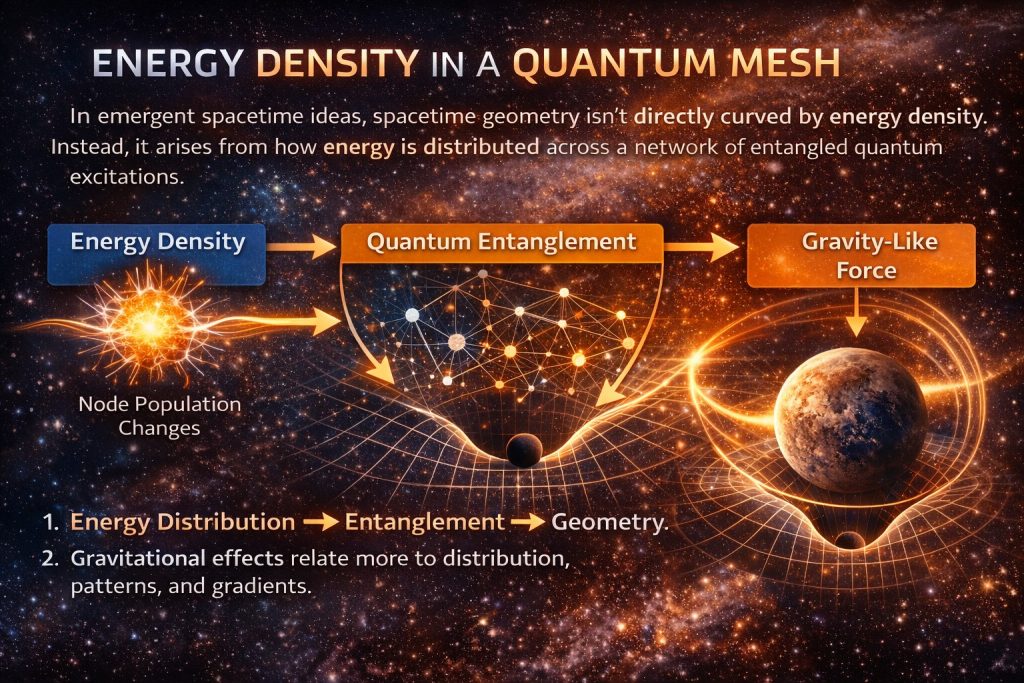
In classical gravity:
- Energy density curves spacetime directly
In emergent models:
- Energy changes quantum state populations
- That alters entanglement patterns
- Those patterns define effective geometry
So instead of:
energy → curvature
We get:
energy → quantum state distribution → entanglement → geometry
This is especially relevant when thinking about the quantum vacuum, which carries enormous zero-point energy yet produces only tiny gravitational effects — a long-standing puzzle in physics.
Emergent geometry may explain this by responding not to absolute energy, but to structure, gradients, and correlations.
Where Electric Fields Enter the Picture
Electric fields are well understood to affect quantum systems:
- They shift energy levels
- Polarize the vacuum
- Modify wavefunctions
- Control entanglement in engineered systems
So the key question becomes:
Do electric fields merely affect excitations within spacetime — or can they influence the deeper entanglement structure that defines spacetime itself?
At present, known physics supports only the first option. Electric fields influence matter and local quantum states, but not the foundational entanglement believed to underlie spacetime geometry.
The Hypothesis: Electro-Gravity as an Emergent Effect
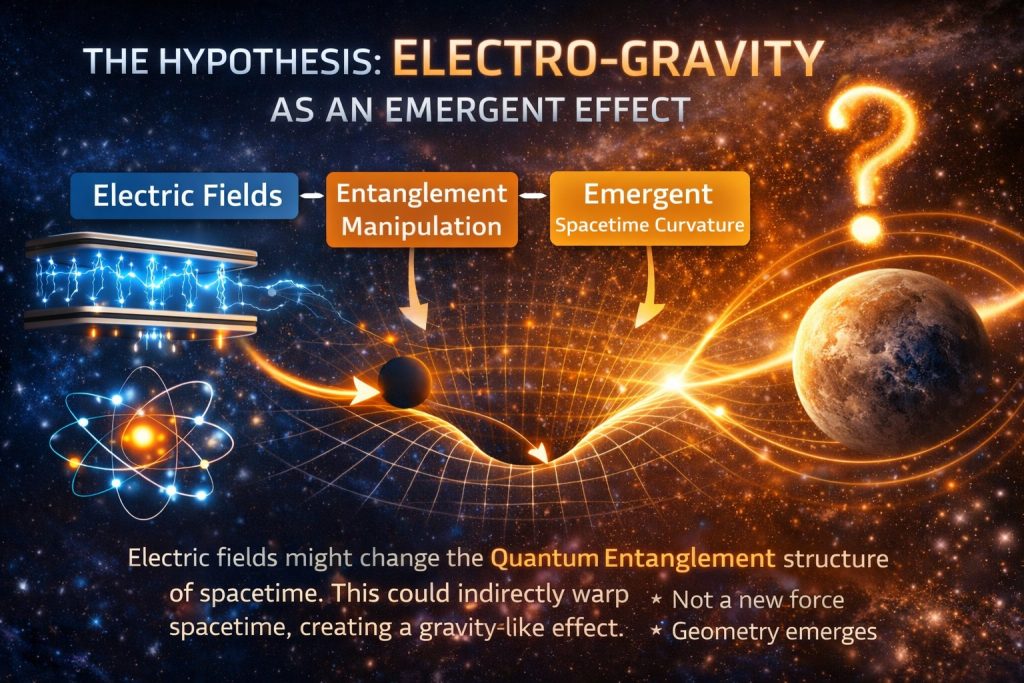
Still, if the following conditions were met:
- Spacetime geometry emerges from quantum entanglement
- Gravity arises from entanglement density gradients
- Electric fields can reorganize vacuum-level entanglement (not just particles)
Then, in principle:
Electric fields could indirectly induce gravity-like geometric effects
Not by acting as a force, but by reshaping the informational structure of spacetime.
This would not be classical gravity.
It would not be propulsion.
It would not violate relativity.
It would be a secondary geometric response — subtle, structural, and likely extremely weak.
Why This Is Hard (and Why Most Attempts Fail)
Historically, “electro-gravity” ideas failed because they assumed:
- Gravity is just another force
- Field energy equals mass directly
- Spacetime is passive
Emergent gravity frameworks reject all three assumptions.
They instead treat gravity as:
- Structural
- Statistical
- Information-driven
Your hypothesis only works under that paradigm — and nowhere else.
Experimental Reality Check
Even if the idea is correct in principle:
- The effect would likely be Planck-scale small
- Far below detectability with current technology
- Not useful for propulsion, shielding, or antigravity
So this is not a claim about engineering.
It’s a claim about conceptual consistency.
A Careful Way to Say It
A defensible formulation would be:
If spacetime geometry emerges from quantum entanglement, and if electromagnetic fields can reorganize entanglement at that foundational level, then gravity-like geometric effects could arise indirectly from electric fields.
That’s speculative — but not incoherent.
Final Thought
Physics may be moving toward a picture where:
- Geometry is not fundamental
- Motion is relational
- Gravity is emergent
- Fields are informationally active
If that’s true, then electric fields influencing gravity is not impossible — just far deeper than early electro-gravity ideas imagined.
Not force.
Not thrust.
But structure.
And sometimes, structure is everything.