Relativity, Quantum Entanglement, and the Search for Unity: Contradiction or Hidden Connection?

In the grand tapestry of modern physics, two threads stand out as cornerstones of our understanding of the universe: Einstein’s theory of relativity and the principles of quantum mechanics. These two frameworks, however, appear to be at odds when we examine certain phenomena—most notably, quantum entanglement. The apparent contradiction between the deterministic, local nature of relativity and the probabilistic, nonlocal features of entanglement has long puzzled physicists. Does this conflict signal a fundamental rupture in our understanding of nature, or could it point towards a deeper, hidden mechanism—a new force or principle—binding the two together?
The Contradiction at the Heart of Physics
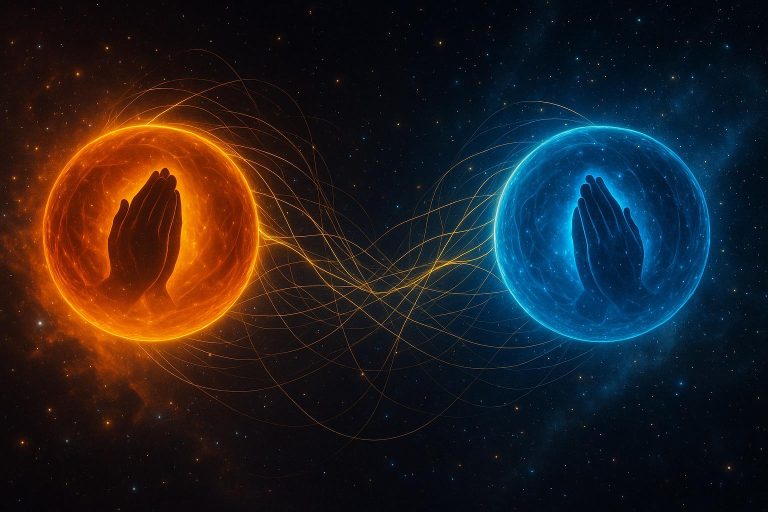
Relativity theory, both special and general, is grounded in the idea that information, matter, and energy cannot travel faster than the speed of light. This speed limit preserves causality and ensures that events remain bound within the light cones of spacetime, maintaining a local and continuous structure of the universe. On the other hand, quantum entanglement—famously termed “spooky action at a distance” by Einstein—suggests that two particles, once entangled, can instantaneously affect each other’s states, even when separated by vast distances. Experimental confirmations of entanglement, such as the violation of Bell’s inequalities, imply that nature is nonlocal in some fundamental way.
This nonlocality seems to violate the locality principle of relativity. How can two particles, light-years apart, influence each other in an instant, without any signal traveling between them? The paradox deepens when we consider the no-signaling theorem in quantum mechanics, which maintains that entanglement cannot be used to transmit information faster than light. Yet the very existence of instantaneous correlations appears to contradict the causal structure of spacetime as described by relativity.
Can a Hidden Force Bridge the Gap?
One speculative resolution is the existence of a deeper, as-yet-unknown force or mechanism that reconciles these differences. Perhaps entanglement is not an interaction in the classical sense, but rather a manifestation of a more fundamental layer of reality where space and time as we know them break down. This idea echoes proposals in certain theoretical frameworks, such as string theory and quantum gravity, where spacetime itself is emergent from a more basic set of principles.
Another possibility is that entanglement and relativity are both emergent phenomena from a shared underlying structure—a “hidden order” or informational field that permeates the universe. Some physicists have suggested concepts like the “pilot wave” theory, the zero-point field, or even emergent gravity, where spacetime geometry arises from entangled quantum states. If such a hidden mechanism exists, it may not be a force in the traditional sense (like electromagnetism or gravity), but rather an organizing principle—an unknown rule of the universe that links the probabilistic world of quantum mechanics with the geometric fabric of relativity.
Toward a Deeper Understanding
The tension between relativity and entanglement challenges us to rethink our assumptions about causality, locality, and the nature of information in the universe. The search for a unified theory—be it through quantum gravity, a theory of everything, or the discovery of a new force or principle—continues to drive cutting-edge research. Concepts like spacetime being emergent, or the universe functioning as a quantum information processor, hint that what we perceive as a contradiction may actually be a clue pointing toward a deeper, more harmonious reality.
In conclusion, while the apparent contradiction between relativity and quantum entanglement is real and pressing, it may not be an irreconcilable divide. Instead, it could be an invitation to explore the unknown—a signpost pointing toward a deeper understanding of the universe. Whether this path leads to a new fundamental force or an entirely novel framework of physics remains an open and fascinating question for the future of science.