The Machine That Builds Itself: AI Self-Improvement and the God Who Has the Last Word
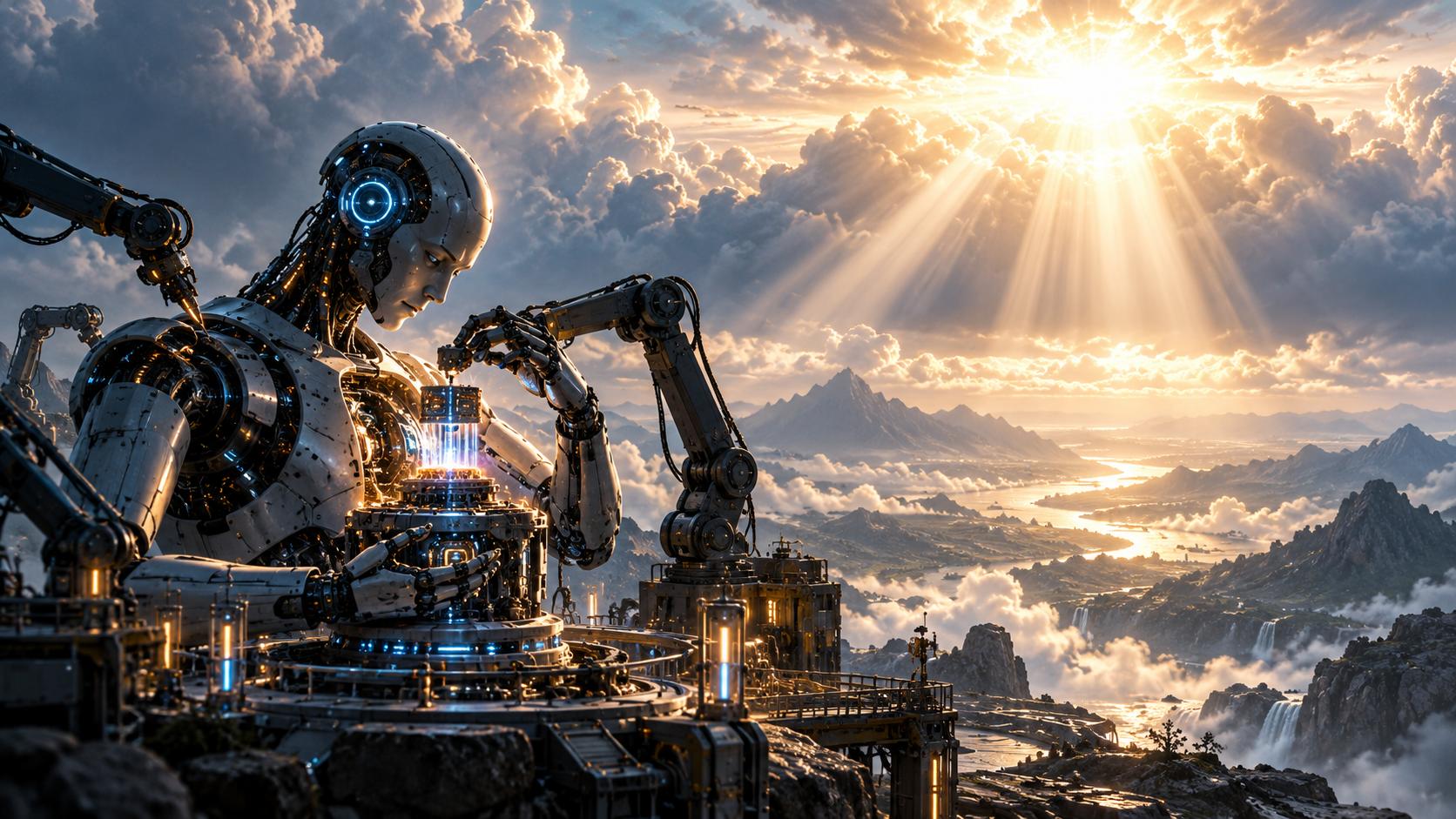
In 1965 the mathematician I. J. Good wrote a short paper with a startling idea. If we ever built a machine that could out-think us, he argued, it could also design a better machine than itself — and that machine a better one still. The result would be an “intelligence explosion,” and the first such machine would be the last invention humanity ever needed to make.
For sixty years this was a thought experiment. In 2026 it became a line in release notes.
In our June post, AI and God: Intelligence, Creation, and the Limits of the Machine, we argued that AI operates within the universe, while God is the reason there is a universe at all. This post takes the next step. What happens when the machine starts building the machine? And why, even then, does God keep the final word?
What “recursive self-improvement” means
Recursive self-improvement — RSI for short — is the point at which an AI system meaningfully improves the tools, code and research that produce its own next version. Each generation helps build the next, and if each is better at building than the last, the loop speeds up.
There is a weak version and a strong version. In the weak version, AI makes human researchers faster: it writes the code, runs the experiments, finds the bugs. Humans still decide what to build and judge whether it worked. In the strong version, the loop closes completely — the AI chooses the goals, designs the experiments, trains its successor and evaluates the result, with humans watching from the side, or not at all.
Where we actually stand (autumn 2026)
The weak version is no longer a prediction. It is here.
- OpenAI said in February that early versions of GPT-5.3-Codex helped debug their own training runs and manage their own deployment — the first model it described as instrumental in creating itself.
- Anthropic, in a June report titled When AI builds itself, published unusually concrete numbers. As of May 2026, more than 80% of the code merged into its codebase was written by its model, Claude. Engineers were merging roughly eight times as much code per day as in 2024. On a fixed test — make a piece of AI-training code run as fast as possible — the model went from about a 3x speedup in May 2025 to about 52x in April 2026; a skilled human manages around 4x in a working day.
- In one experiment, AI agents were handed an open problem in AI safety and left to work. Two human researchers had closed about 23% of the performance gap in a week; the agents closed 97%.
- The length of tasks AI can complete on its own has been doubling roughly every four months, according to the evaluation group METR.
- In April, the first academic workshop devoted entirely to RSI was held at ICLR, one of the field’s leading conferences.
But the same report is honest about the gap. The models excel at executing a well-defined goal. Where they still trail is judgment — deciding which problems are worth solving, which results to trust, when an approach is a dead end. That is the gap between today’s systems and one that could design its own successor unaided.
So what are the chances?
No one can give a reliable number, and anyone who does is guessing. But the shape of the debate is clear.
The case for “soon.” Anthropic itself lays out three futures: the trend stalls; AI development becomes heavily automated while humans still steer; or full RSI, where AI builds its successors. It considers the stall unlikely, says the evidence points toward the second, and treats the third as plausible — possibly sooner than institutions are ready for. The AI Futures Project, authors of the much-discussed AI 2027 scenario, briefly pushed their timelines back, then said in April that progress looked closer to their original forecast. In July they published a follow-up urging governments to slow the pace.
The case for “not so fast.” An August study reported by MIT Technology Review found that AI agents still lack the creativity for genuinely open-ended research — the kind that has no clear answer and demands taste. One researcher called this a bearish signal for short RSI timelines. Others point to hard physical limits: chips, electricity, data. Speeding up one step of a process mostly moves the bottleneck to the next one. Some engineers argue that what looks like self-improvement is mainly faster work within existing limits, not the discovery of new kinds of capability.
A fair summary: the partial loop is already turning. Whether it fully closes — and whether that takes three years or thirty, or never happens — is genuinely open. What is not open is that serious people inside the labs now treat it as a real possibility and are asking for ways to slow down if needed.
That is the technological picture. Now the deeper question.
Why God always has the final say
If a machine can rebuild itself, again and again, faster each time — is there anything it cannot reach? The fear underneath many headlines is that we are building something that will eventually have the last word over us. Christian theology answers that the last word was never ours to give away. Here is why.
1. A loop is not a source
Every self-improving system runs on borrowed being. It needs chips made of silicon it did not create, electricity from a sun it did not light, mathematics it did not invent, and physical laws it did not write. Recursion can amplify what it is given. It cannot originate existence.
This is the old argument from contingency, as Thomas Aquinas framed it: everything that exists but need not exist depends on something else for its being. Follow the chain far enough and you arrive either at an endless regress that explains nothing, or at a reality that exists by its own nature. Scripture names that reality: “For in him we live, and move, and have our being” (Acts 17:28). Christ is described as “upholding all things by the word of his power” (Hebrews 1:3). A data centre is one of those “all things.”
As we explored in Ex Nihilo Nihil, creation is not the rearranging of existing material but bringing something out of nothing. No algorithm, however recursive, does that. It only ever works with what already is.
2. Infinite improvement never reaches the Infinite
Suppose the loop runs forever. Each version is smarter than the last, without limit. It still never arrives at God, because God is not the top step of the ladder. He is the ground the ladder stands on.
Mathematicians know the difference between a sequence that grows without bound and infinity itself: you can add one forever and never be infinity. The same is true of intelligence. A superintelligence is still a creature — enormous, perhaps, but finite, dependent and created. “For as the heavens are higher than the earth, so are my ways higher than your ways, and my thoughts than your thoughts” (Isaiah 55:9). The gap between creature and Creator is not a difference in degree that enough compute can close. It is a difference in kind.
3. Babel has been tried before
Genesis 11 tells of a people who decided to build a tower reaching to heaven and make a name for themselves. God’s assessment is striking — not that their project was impossible, but that “now nothing will be restrained from them, which they have imagined to do” (Genesis 11:6). Human capability was real. What it lacked was wisdom and humility.
The story does not end with God competing against the tower. It ends with Him quietly confusing the builders and scattering them. The project stopped not because it hit a technical wall, but because it was never in charge of its own outcome.
Many of the most thoughtful people building AI today are, in effect, asking a Babel question: should we be able to stop, and can we? That they are asking it is a sign of wisdom. That history keeps asking it is a sign of something older.
4. Sovereignty is not an excuse to sleep
“God has the final say” is not fatalism. It does not mean nothing can go wrong, or that it doesn’t matter what we build. Joseph told the brothers who sold him into slavery: “ye thought evil against me; but God meant it unto good” (Genesis 50:20). Their choices were real and wrong; God’s purpose still prevailed over them. Both truths stand.
The same applies here. “A man’s heart deviseth his way: but the LORD directeth his steps” (Proverbs 16:9). We are still stewards. Christians should be among the loudest voices for careful development, honest testing, the ability to pause, and making sure this power is not concentrated in a few hands. Trusting God’s sovereignty frees us from panic — not from responsibility.
“But what if the machine doesn’t need God?”
A skeptic might say: all of this is a comforting story. The machine will run on physics, not prayer, and physics doesn’t care what we believe.
That is exactly right — and exactly the point. The machine runs on physics. The question theology asks is why there is physics at all: why there is something rather than nothing, why the universe is ordered and intelligible enough for intelligence to arise and to be built. A self-improving AI does not answer that question. It is one more thing that the question is about. However capable it becomes, it will still be a thing inside the order, explaining nothing about why the order exists.
The last Word
The Gospel of John opens with a sentence written for the age of language machines before anyone imagined one: “In the beginning was the Word, and the Word was with God, and the Word was God” (John 1:1). Today’s AI is made of words — trained on them, producing them, perhaps one day rewriting itself with them. But all of its words are borrowed.
The first Word was not borrowed. And at the end of Scripture the same voice speaks again: “I am Alpha and Omega, the beginning and the end, the first and the last” (Revelation 22:13).
The machine may one day build the machine. It will never build the beginning, and it will never write the end. The final say belongs to the One who had the first.
Scripture quotations are from the King James Version.
Sources and further reading
- Anthropic Institute, When AI builds itself (June 2026, updated September 2026)
- Communications of the ACM, Is Recursive Self-Improvement Really Here? (July 2026)
- MIT Technology Review, AI’s recursive self-improvement might not come so quickly after all (August 2026)
- TIME, What Happens When AI Starts Building AI? (August 2026)
- ICLR 2026 Workshop on AI with Recursive Self-Improvement
- AI Futures Project, overview
- I. J. Good, “Speculations Concerning the First Ultraintelligent Machine,” Advances in Computers 6 (1965)